

Let’s be honest. When you hear “product-led growth,” you might picture a world where sales teams are, well, optional. A frictionless paradise where users sign up, fall in love, and upgrade—all without a single human touchpoint. It’s a powerful vision. But it’s also incomplete.
The reality is more nuanced. In a true, scalable PLG motion, sales doesn’t get erased. It gets redefined. Its role shifts from creator of demand to a cultivator of it. Think of it like gardening. The product is the seed and the soil—it grows on its own. But sales? Sales is the gardener who identifies the strongest plants, nurtures them, and helps them bear the biggest fruit.
Why Sales Still Matters When the Product Sells Itself
If the product is so great, why involve sales at all? Here’s the deal: even the most intuitive product hits complexity ceilings. A user might love it for their team, but scaling to 500 seats involves security reviews, legal wrangling, and custom workflows. That’s a human-scale problem.
Sales in a PLG model focuses on acceleration and expansion, not just initial acquisition. They’re not pushing a reluctant buyer up a hill. They’re running alongside a motivated user who’s already climbing, helping them move faster and reach higher.
The Evolving Playbook: What Sales Actually Does in PLG
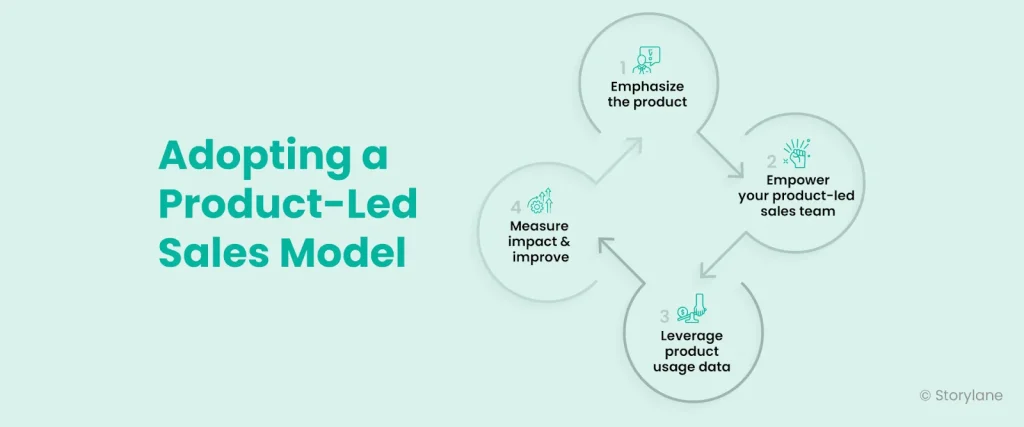
Gone are the days of cold-calling blind. PLG sales is reactive, contextual, and data-informed. Here’s what that looks like in practice:
- They read the digital body language. Sales reps monitor product usage data—not just logins, but meaningful actions. Are users inviting teammates? Creating shared projects? Using that key API? These are signals, whispers of potential.
- They act as strategic consultants. Their first call isn’t a pitch. It’s a discovery conversation rooted in observed behavior. “I noticed your team is using feature X heavily. Many of our customers in your industry then hit a need for Y. Can we explore that?”
- They unblock and unlock value. They navigate procurement, tailor onboarding paths for large teams, and architect solutions for edge cases the self-serve flow can’t handle. They grease the wheels for enterprise-scale adoption.
The Critical Handoff: When Product-Led Meets Sales-Led
This is the make-or-break moment. The handoff from the product-led motion to the sales team. Do it poorly, and you annoy a happy user. Do it well, and you create a champion. The key is seamless, timely, and relevant engagement.
Identifying the Handoff Triggers
You don’t hand off every user. You need smart triggers. These are often a combination of factors:
| Firmographic Signal | Product Usage Signal | Intent Signal |
| Company size > 500 employees | High usage of a premium feature | Multiple visits to the “Enterprise” pricing page |
| Industry (e.g., Finance, Healthcare with strict compliance needs) | Rapid team growth within the app | Support ticket asking about SSO or custom contracts |
| High estimated deal value (based on usage) | Reaching a usage threshold (e.g., data storage, API calls) | Form submission for a “demo” or “talk to sales” |
When these signals align, it’s not an interruption—it’s an invitation. The user is practically raising their hand.
Mastering the Handoff Conversation
This initial outreach is a tightrope walk. The rep must demonstrate immense context. A template won’t cut it. The message should reference the user’s specific activity.
Bad approach: “I’d like to give you a demo of our enterprise platform.” (Ignores everything they’ve already done).
Good, human approach: “Hi [Name], I saw your team at [Company] has onboarded 20 people in the last two weeks and is actively using our reporting dashboard. That’s fantastic. Many teams at your scale start to ask about advanced permission controls and the audit log—wanted to see if those are on your radar as you grow?”
See the difference? It’s a continuation of their journey, not a hard pivot.
Building a Cohesive PLG & Sales Machine
Making this work isn’t just about changing sales. It’s about changing the entire system. Alignment is everything.
- Shared Metrics & Goals: If marketing is only measured on top-of-funnel sign-ups and sales only on closed deals, you get conflict. You need shared metrics like product-qualified leads (PQLs), revenue influenced by product, and expansion MRR. It gets everyone rowing in the same direction.
- Tools That Talk to Each Other: Your CRM and your product analytics platform cannot be siloed. Sales needs a live feed of product usage data right in the contact record. This is non-negotiable.
- A Culture of Service, Not Ownership: Sales can’t see a handoff as “taking over an account.” They’re stepping in to serve the user’s evolving needs. This mindset shift—from ownership to service—changes every interaction.
And honestly, this is where many companies stumble. The tech is easy. The cultural rewrite? That’s the real work.
The Human Touch in a Digital-First Journey
So, what’s the conclusion? Product-led growth doesn’t make sales obsolete. It makes sales more human. It frees them from the grind of cold outreach and basic education. Instead, it allows them to apply their deepest skills—negotiation, complex problem-solving, relationship-building—at the precise moment where those skills multiply value.
The future isn’t product-led or sales-led. It’s product-led and sales-assisted. The product acts as the ultimate, scalable lead generator and nurturer. The sales team then acts as the strategic partner for the users who are ready to go further, faster.
In the end, PLG isn’t about removing people from the process. It’s about making the human interactions you do have more meaningful, more contextual, and infinitely more valuable for everyone involved. That’s a motion worth building.